
Manuela’s Turning Point: Access and Authenticity
Manuela* is a junior who arrived this year after moving from Colombia to Miami, and then to Connecticut. The transition has not been easy.
She told me that she fit in Miami, “It is like Colombia.”
Here, in a more English-dominant setting, she has struggled. She has said more than once that she wants to go back. She made it clear through her body language that she feels misunderstood. In her first few weeks, there were a lot of eye rolls and very few smiles.
Then this unit started, and something shifted.
Why Authentic Assessments Matter
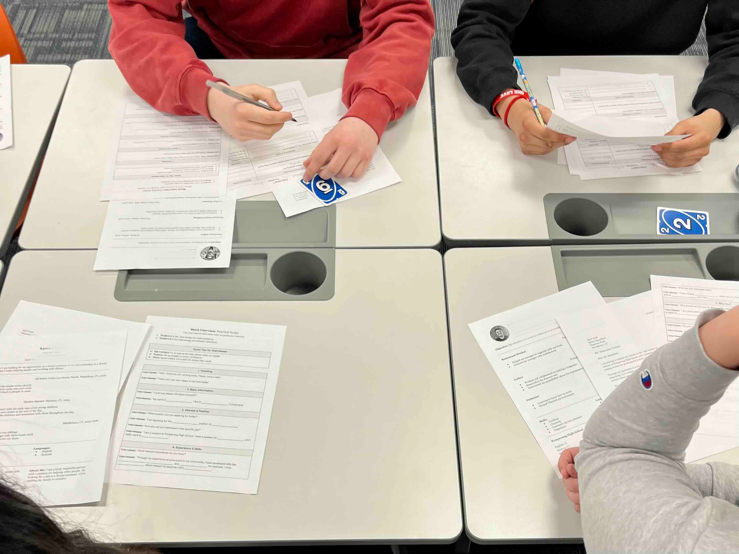
Students went through several rounds of in-class practice to prepare for the end of unit event.
One of the persistent challenges in working with multilingual learners (EL/MLs) is making abstract ideas feel real. Concepts like “future planning” or “career pathways” can feel distant, especially for students who are still adjusting to a new language, school system, and community.
For Manuela, school had largely been about navigating confusion. She spent her energy trying to understand instructions, keep up with unfamiliar expectations, and manage frustration. But this unit asked something different of her. Instead of hypothetical tasks, students were asked to do real things: create resumes, write cover letters, and prepare for interviews.
Manuela suddenly had something to say.
When she worked on her resume, she was able to draw on her experiences in Colombia and Miami: jobs, responsibilities, and skills that had not previously had a place in her schoolwork. The task positioned her not as a struggling English learner, but as someone with experience worth communicating.
This is the power of authentic work. It does more than increase engagement; it gives students a reason to use language.
Building a Shared Language Foundation
Of course, authenticity alone is not enough. Students need structured support to access both the content and the language.
The unit began with a vocabulary sort routine where students built a shared understanding of key vocabulary and concepts: pathways, qualifications, and steps toward a goal. This created a foundation that they could return to throughout the unit.
For students like Manuela, this was essential. Instead of encountering unfamiliar words in isolation, she saw them repeatedly, connected to ideas she was actively working with. Routines like the Agreement Continuum, Generate-Sort-Connect-Elaborate, and scenario-based tasks gave her space to form opinions and practice language with low-stakes.
The goal was not just exposure to vocabulary, but usable language tied to meaningful decisions.
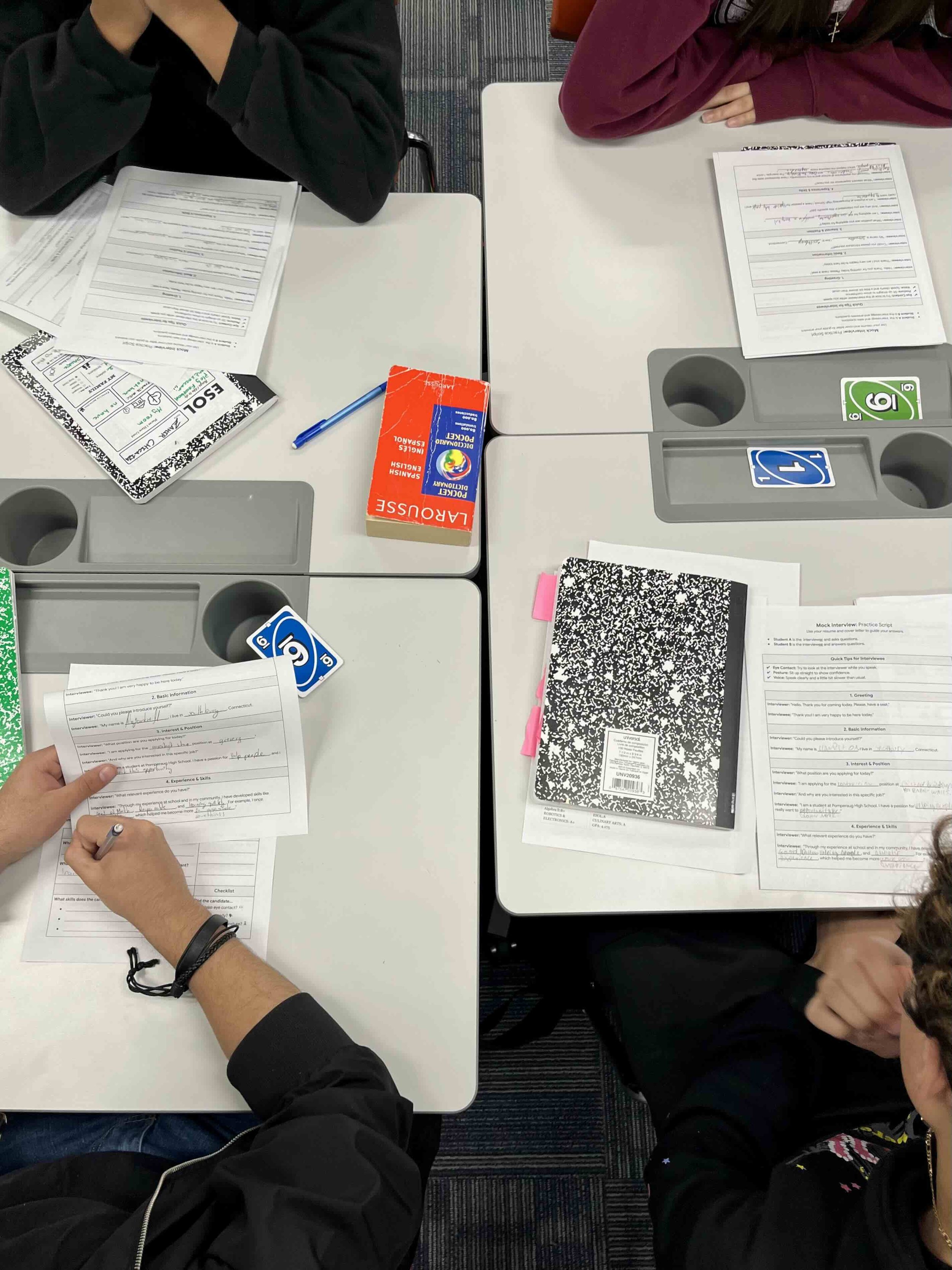
In this practice session, students used resumes, cover letters, and scripts to interview each other. Candidates were responsible for speaking clearly about their qualifications while interviewers asked for clarification and recorded key details.
Connecting Present Reality to Future Goals
A key shift in the unit was connecting important abstract questions, “Where do you see yourself in 5 to 10 years?” to more grounded ones: “What are you already doing, and what are realistic next steps?”
Early in the unit, we collaborated with our school’s career center. Students visited and worked with counselors to explore potential career paths using Naviance. This gave students exposure to a range of options, but more importantly, it helped them begin thinking concretely about what those paths actually require.
From there, students were asked to consider realistic next steps toward those careers. Rather than jumping straight to long-term goals, they focused on what comes next: additional schooling, entry-level jobs, or skill development. Their resumes and cover letters were then geared toward those realistic next steps.
Students also reflected on their current responsibilities (jobs, family roles, and school habits) and identified the skills embedded in those experiences. Scenario-based dialogues helped them analyze different situations and give advice, reinforcing the connection between actions, skills, and future pathways.
For Manuela, this was another turning point. Her experiences, which may have felt disconnected from school, became relevant. She was building toward something.
Making Language Comprehensible
To make this work accessible, the unit relied on consistent scaffolds:
Explicit vocabulary instruction supported by a visual word wall
Sentence frames and models to support speaking and writing
Structured templates for resumes and cover letters
Repeated practice with key vocabulary across activities
Gradual release from scripted to more independent responses
Manuela relied heavily on these supports, especially during interview preparation. She practiced responses, memorized parts of them, and leaned on that structure during the final event.
The goal was not perfection but participation with increasing clarity and confidence.
Simulated Interviews Event
We returned to the Career Center for our end of unit event: simulated interviews. Twenty adults from within and outside of our school community arrived to interview the students.
By the time we reached this stage, they had rehearsed both the language and the experience. They had practiced with partners, in front of the entire class, and worked toward more independent responses.
For the event, we encouraged students to dress professionally. Some brought clothes to change into. Manuela arrived at school dressed in a pantsuit and high heels.
Her interview responses were not flawless. She relied on her practiced scripts. But her demeanor was entirely different. She smiled. She engaged. After one interview with a district staff member, she gave a big grin and double thumbs-up.
Later, she came over holding a stack of feedback cards.
“Mr. Hull, I have six cards! I have six jobs!”
It was a small moment, but it reflected something significant. She was proud of her English and how she presented herself, her experiences, and her potential.
Final Thought
The strength of this unit was not in any single activity, but in the combination of authenticity and support. Students were asked to do real work, and they were given the tools to do it.
For Manuela, that combination made school feel different. She was no longer just trying to keep up. She was contributing, participating, and, at moments, leading with confidence.
This is not unique to one student. When EL/MLs are given meaningful tasks and the language support to access them, they often reveal a different side of themselves.
More broadly, this approach is not limited to career-focused units. Across disciplines, when students use language to do something real — and are supported in doing so — they are more likely to engage deeply and see themselves as capable learners.
Manuela still has a lot to figure out. The transition is ongoing. But during this unit, she experienced something important: she saw herself not just as a student learning English, but as someone preparing for a future she could actually picture.
*Manuela is a pseudonym and some information was changed to protect the identity of the student.