
Sentence Scrambles as a Bridge to Writing
Edwin* is a sixth grade newcomer. It has been a tough year for him, but he recently found a place where he fits.
A few weeks ago, Edwin joined the crochet club, and it quickly became part of his routine. He is still developing social English and academic vocabulary in English and Spanish. School has never come easily to him in any language.
What he does have is strong fine motor skills and patience. Crocheting gave him a way to participate, contribute, and connect with other students without relying heavily on language.
For his nonfiction writing project, Edwin chose to write about the mental health benefits of crocheting. The topic made sense. It was something he knows and cares about. The difficulty came when he tried to turn those ideas into English sentences. He could explain his thinking verbally or in Spanish, but writing it in English felt like too big a jump.
I was stumped. As I drove over to the high school, I mulled it over. How can we make this a meaningful writing experience for him?
I arrived at the high school and entered Gabby’s* 11th grade English class. Gabby is also a beginner-level student, and she’s working on a literary analysis of Paul Coehlo’s The Alchemist.
She understands the major themes of the novel and has access to a Spanish version, which helps her engage deeply with the text. When it comes to writing in English, though, she often gets stuck. Her usual approach is to write in Spanish and use a translation tool.
The result is technically correct, and it reflects how she thinks, but it has not helped her build confidence as a writer in English.
These two students are in very different places academically, but they were running into the same problem. They both had ideas. They both struggled to turn those ideas into clear English sentences.
I went through my mental bag-of-tricks. In both cases, sentence scrambles would be the way forward.
Starting with Edwin
With Edwin, the priority was making writing feel manageable. Instead of asking him to generate full sentences, I gave him sentences that were already written and broke them into meaningful parts.
The structure stayed consistent:
the subject stayed together
the verb or verb phrase was separate
dependent clauses were on their own
For example:
feel / you / better / when you crochet
His job was to put the sentence back together. Because the vocabulary was already there, he could focus on meaning and structure. He was not searching for words. He was working with them.
As we continued, the sentences connected directly to his topic:
repeated motion. / Crocheting / uses
are good / Repeated motions / for the brain.
can help you / Crocheting / feel better when you are sad.
“knitting distracts the brain” / According to the Anxiety Resource Center, / (Houtman, AnxietyResourceCenter.org).
gives / you a purpose. / It
He practiced these repeatedly, and the patterns started to stick. When it was time to write on his own, he was not starting from nothing. He had already worked with the language he needed.
Moving to Gabby
Gabby needed the same structure, but we started from her ideas instead of prewritten sentences.
She began by explaining her thinking in Spanish. From there, we pulled out key words and phrases and identified cognates when possible. For one idea, we worked with:
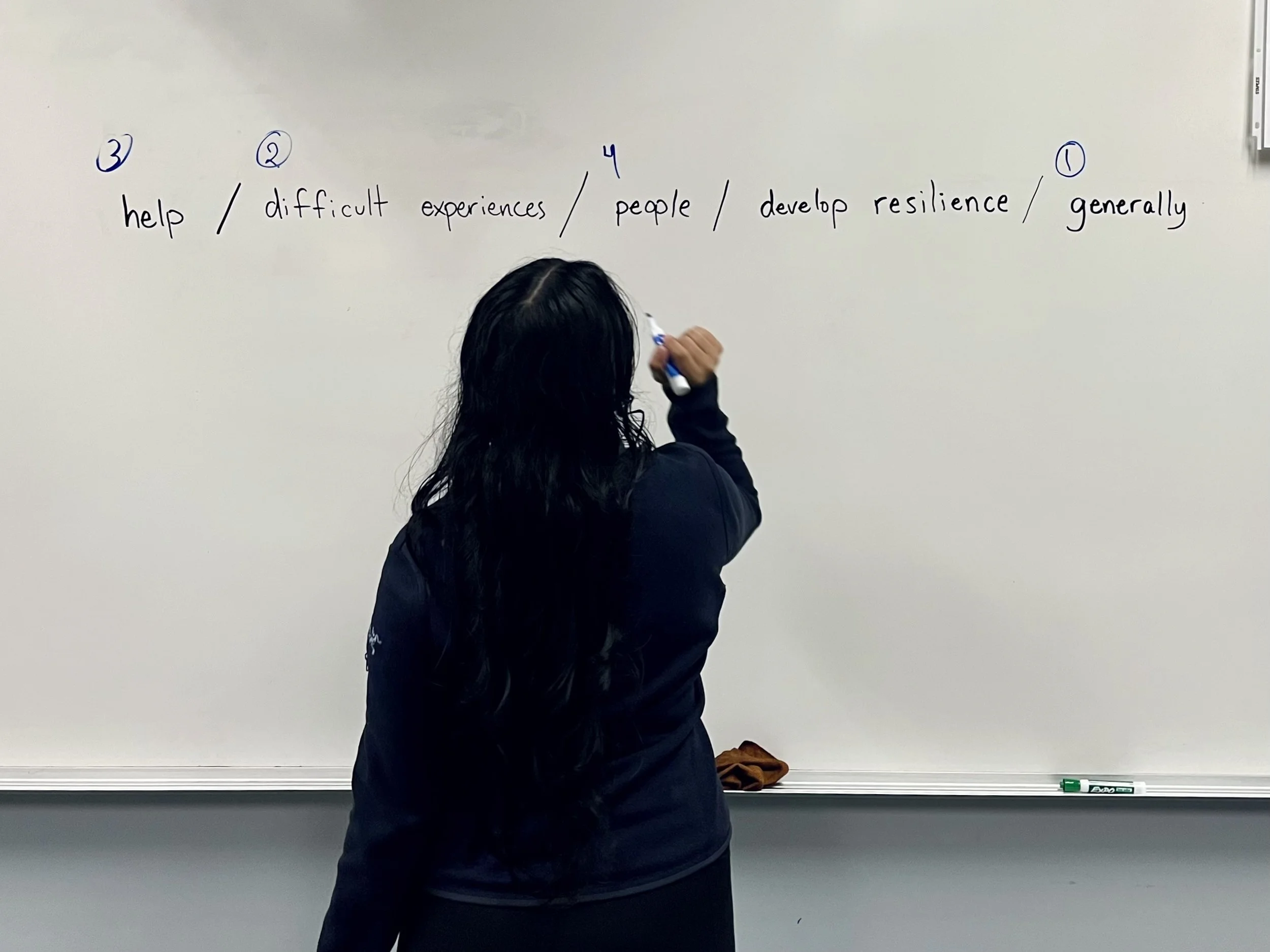
Gabby works at the whiteboard before returning to her paper.
Her resulting sentence: “Generally, difficult experiences help people develop resilience.”
help / difficult experiences / people /develop resilience / generally
Instead of asking her to write a sentence, I turned those into a scramble. She numbered the parts in the order that made sense to her.
Because we had already discussed the ideas in the text and the vocabulary, she could focus on how the sentence should come together.
Once she had the order, she wrote the sentence. We repeated this process for each sentence in her paragraph. Over time, she relied less on translation and more on constructing sentences directly in English.
Why Sentence Scrambles Work
In both situations, sentence scrambles reduced the complexity of writing without lowering expectations.
For Edwin, they made writing accessible. He could participate in the task without being blocked by vocabulary.
For Gabby, they preserved the complexity of her thinking while giving her a structure to express it.
The strategy works because it:
separates ideas from language production
makes sentence structure visible
reinforces patterns through repetition
gives students a clear starting point
Students are not guessing. They are building.
Designing the Scrambles
The way sentences are broken apart matters.
subjects stay intact
verbs are separated
dependent clauses stand alone
phrases are meaningful, not random
For example:
you / feel / better / when you crochet
crocheting / is / a healthy activity
people / can develop / resilience
Each scramble pushes students to think about how sentences work, not just what they say.
From Sentences to Paragraphs
After working through multiple scrambles, both students were able to write more independently.
Edwin wrote about crocheting in a way that reflected his experience and understanding.
Gabby wrote an analytical paragraph about The Alchemist without relying entirely on translation.
In both cases, the shift was noticeable. Writing became less about getting stuck and more about putting ideas together.
Final Thought
Sentence scrambles are often treated as a quick activity or a warm-up. Used consistently and intentionally, they can do much more than that.
They give students a way to practice how English works while staying connected to meaningful ideas. For students who already have something to say but are not sure how to say it, that structure makes a difference.
For Edwin and Gabby, it was enough to get them writing.
Edwin and Gabby are pseudonyms and some information was changed to protect the identity of the students.