
Using a Weekly Newsletter to Support Multilingual Learners Across Schools
As school districts expand services for multilingual learners, many educators now work across multiple buildings, departments, or grade levels. These cross-building roles are essential, but they come with a challenge that often goes unspoken: how do you build trust, coherence, and instructional consistency when you cannot be everywhere at once?
For years, I worked in a single school. Being physically present every day allowed me to build deep relationships with students and staff, collaborate regularly with content teams, and become a trusted part of the school community. When my role shifted to supporting multilingual learners across multiple schools, I worried about losing that embeddedness.
I knew I needed a way to stay connected, useful, and visible without adding to teachers’ already full plates. One of the most effective strategies I found was a weekly staff newsletter.
Not as a compliance tool. Not as an information dump. But as a deliberate system for connection and capacity-building.
Why a Weekly Newsletter Works in Cross-Building ML Roles
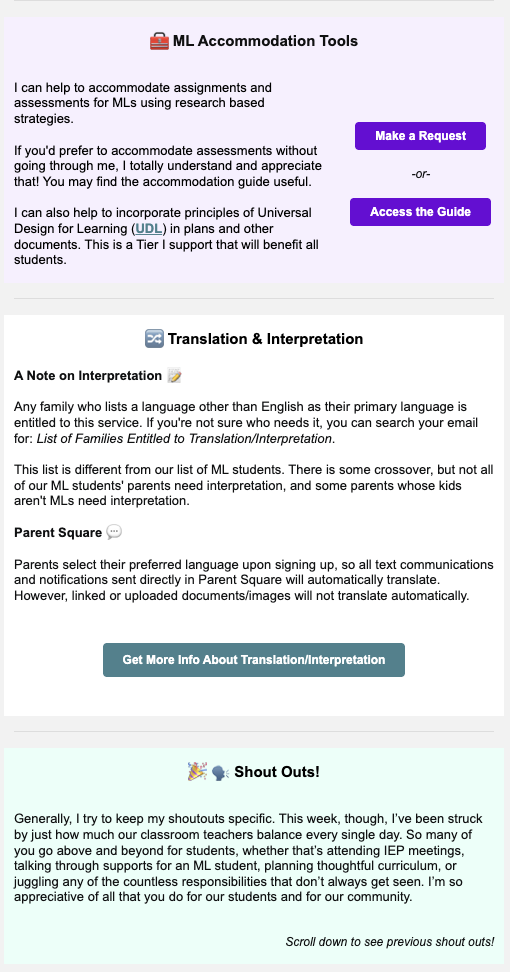
A screenshot from one of my recent newsletters.
The newsletter did not start as a communication goal. It started as a systems need.
Supporting multilingual learners across multiple schools means navigating different schedules, instructional approaches, and building cultures. It also means fewer informal conversations and fewer opportunities to reinforce shared practices in real time.
I needed a structure that allowed me to:
Share consistent guidance on supporting multilingual learners
Reinforce strong Tier I instruction and UDL-aligned practices
Normalize questions about language, assessment, and accommodations
Reach teachers whether or not I was physically present
A short, predictable weekly newsletter became the most sustainable solution.
The Newsletter Was Never the Goal
From the beginning, I was clear about one thing: the newsletter itself was not the work.
It started as a way to simply let teachers know when I’d be present in their classrooms. It grew into a tool to make that support visible and accessible.
That mindset shaped every decision I made. I was not trying to demonstrate expertise or cover everything at once. I was trying to offer something teachers could actually use.
Each newsletter focused on:
One clear instructional idea
One or two immediately actionable strategies
Language that respected teachers’ professionalism and time
If something required extensive explanation or multiple caveats, it did not belong in a weekly format.
Writing for How People Actually Read
One of the most important lessons I learned was accepting how teachers engaged with newsletters.
They skim. They scroll. They look for something useful.
Once I stopped writing as if people were reading closely, the newsletter became more effective. I intentionally:
Used short paragraphs and bullet points
Avoided unnecessary jargon
Linked resources with screenshots of the resource
Framed ideas as invitations rather than expectations
This approach lowered the barrier to engagement and increased the likelihood that strategies would be tried, adapted, or discussed.
Over time, teachers began referencing ideas from the newsletter in meetings, emails, and classroom conversations. That feedback told me the format was working.
Reinforcing Instructional Priorities Over Time
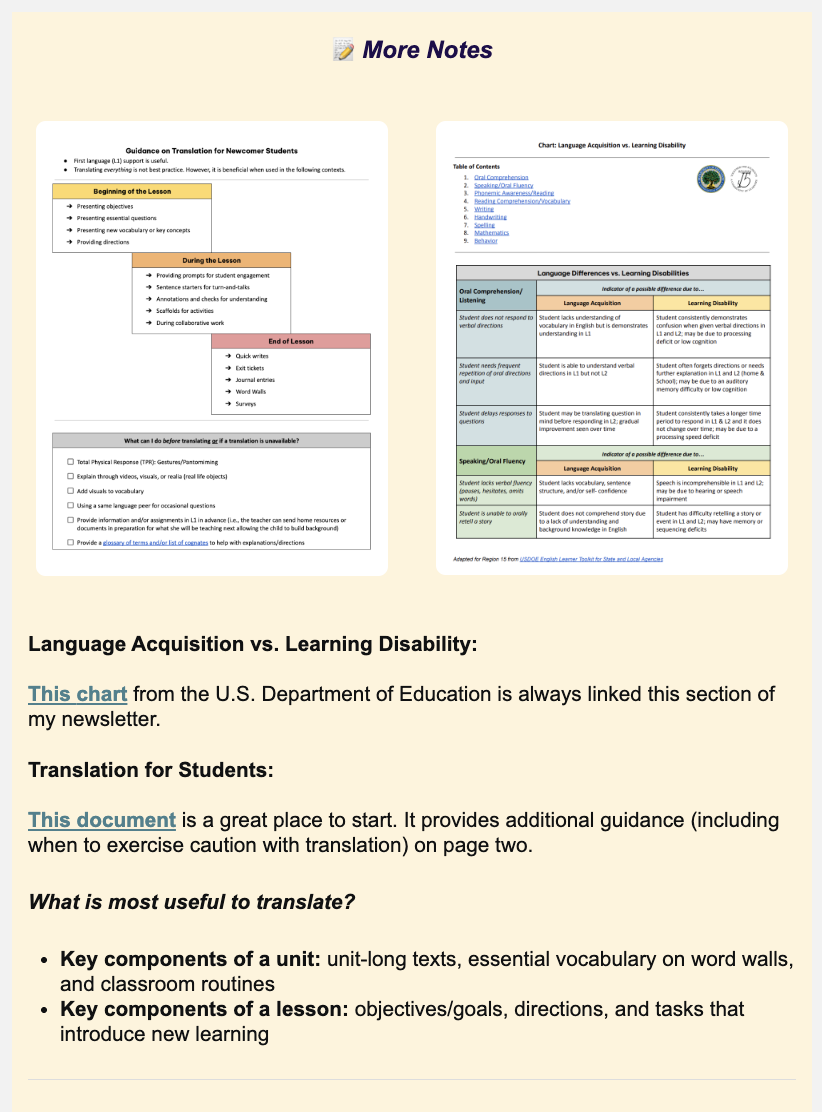
The “More Notes” is a great place to include documents and information connected to frequently asked questions or recurring conversations.
One major advantage of a weekly newsletter is that it allows you to reinforce big instructional ideas gradually.
Across the year, the newsletter revisited topics such as:
Tier I instruction for multilingual learners
Language and content objectives
Comprehensible input
Academic vocabulary development
Scaffolds versus accommodations
Accessible assessments
Supporting long-term multilingual learners
Rather than addressing these topics all at once, I returned to them in different contexts and with different entry points. A sentence expansion routine one week. An accommodations chart the next. A reflection on long-term MLs later in the year.
This repetition helped build shared understanding without requiring constant formal training.
Making Systems Visible and Usable
Alongside instructional strategies, the newsletter was also used to introduce and reinforce practical systems, such as:
An accommodations request form
Reference charts distinguishing language acquisition from learning disabilities
Sentence frames and scaffolded discussion tools
Examples of assessment accommodations that preserve rigor
The newsletter did not just announce these tools. It modeled how and when they could be used.
What made these systems effective was not their design, but teacher engagement. Teachers used them, gave feedback, and helped improve them. The newsletter created a feedback loop that allowed systems to evolve based on real classroom needs.
Respecting Teacher Capacity and Choice
One intentional decision was allowing teachers to unsubscribe easily.
Teachers have limited capacity, and not every resource is relevant at every moment. Offering flexible options, such as pausing weekly emails or receiving only major updates, communicated respect for teachers’ time and autonomy.
This choice did not reduce engagement. In many cases, it strengthened trust. Teachers who stayed subscribed did so because the content felt useful, not obligatory.
Redefining the Role: From Embedded to Connector
Working across schools required a shift in how I understood my role. I was no longer primarily an embedded colleague in one building. I became a connector, translator, and curator of ideas.
The weekly newsletter helped bridge gaps between:
Research and classroom practice
Systems and individual teachers
Language development and content instruction
It allowed me to show up consistently, even when my physical presence was limited.
Practical Guidance for Instructional Coaches and ML Specialists
For educators considering a similar approach, a few principles stand out:
Start small. One clear idea per week is enough.
Assume goodwill. Teachers want to support their students.
Prioritize usability over completeness.
Revisit ideas intentionally.
Invite feedback and adjust.
Respect autonomy and choice.
A newsletter will never replace in-person collaboration, but it can extend reach, reinforce shared priorities, and create coherence across schools.
A Brief Case Study: What This Looked Like in Practice
Over the course of the year, the newsletter became a consistent touchpoint for teachers across multiple secondary schools. Teachers began referencing strategies from the newsletter during planning meetings and reaching out with more specific questions about accommodations, language objectives, and assessment design.
One example came from a social studies team that adopted sentence expansion routines highlighted in the newsletter. Another involved multiple teachers using the accommodations request form to proactively plan supports for multilingual learners before units began. In several cases, conversations sparked by newsletter content led to co-teaching opportunities and deeper collaboration.
The newsletter did not create these outcomes on its own. It created the conditions for them by keeping ideas visible, approachable, and connected to daily practice.
Why This Matters for Multilingual Learners
For multilingual learners, consistency across classrooms and buildings matters. When teachers share a common understanding of language development, instructional scaffolds, and appropriate accommodations, students benefit.
The weekly newsletter became one small but meaningful way to move toward that consistency, not by mandating change, but by inviting it.
Final Reflection
In roles that span multiple schools, connection does not happen by accident. It has to be designed.
For me, a weekly newsletter became one of the most effective tools for staying connected to staff, supporting instructional practice, and advocating for multilingual learners in a sustainable way.
It was never about the newsletter itself.
It was about showing up consistently with something useful, thoughtful, and grounded in classroom reality.