
Unlock Complex Content with Simple Sentences
Teaching multilingual learners to access complex content often involves a real tension.
On one side, teachers want to challenge students with rich, rigorous ideas. On the other, language barriers (limited vocabulary, unfamiliar sentence structures, or gaps in background knowledge) can make even the most engaging content difficult to access. Many educators feel pulled between pushing for conceptual understanding and slowing down to scaffold language.
But what if teachers can do both by working carefully at the level of sentences? What if the sentences themselves became a vehicle for learning content and developing literacy at the same time?
Why Language Matters
Research in literacy and second language acquisition consistently shows that structured, intentional language work is essential for multilingual learners. The Science of Reading reminds us that comprehension depends not only on decoding, but also on vocabulary, sentence structure, and background knowledge.
For multilingual learners, scaffolding these elements can be the difference between comprehension and confusion.
Several evidence-based approaches provide practical tools for this work, including the Hochman Method (with inspiration from Writing is Thinking), Jeff Anderson’s Patterns of Power, and SIOP strategies. Each of these approaches treats language as something students can actively manipulate to deepen their thinking about content.
Kernel Sentences
At the heart of each of these approaches is a simple but powerful idea: start with sentences. Structured sentence-level instruction allows teachers to target the language students need to express content knowledge clearly while also building reasoning skills. The Hochman Method provides one particular strategy that I find to be particularly useful: sentence expansion.
A teacher begins with a simple “kernel” sentence, and students add clauses, appositives (interrupters), or precise vocabulary to make the sentence more informative and nuanced.
For example:
Kernel: “They struggle with it.”
Who? . . . . . . . . . . . . . . . . . . . . . . . . . . . . . . . . . . . . . . . . . . . . . . . . . . . . . . . .
What? . . . . . . . . . . . . . . . . . . . . . . . . . . . . . . . . . . . . . . . . . . . . . . . . . . . . . . . .
Expanded: “Some students struggle with complex sentence structure.”
Through this expansion, students connect ideas, experiment with syntax, and explicitly link language to content. These are core skills for reading, writing, and thinking.
Applying Sentence Expansion Across Content
Sentence expansion is not just a literacy strategy. When aligned with content, it gives students access to complex ideas across disciplines.
Science example:
Kernel: “Water undergoes a change.”
When? . . . . . . . . . . . . . . . . . . . . . . . . . . . . . . . . . . . . . . . . . . . . . . . . . . . . . . . .
How? . . . . . . . . . . . . . . . . . . . . . . . . . . . . . . . . . . . . . . . . . . . . . . . . . . . . . . . .
Expanded: “Water undergoes a change at 100°C, the temperature that causes it to transform into gas.
Social studies example:
Kernel: “The Declaration of Independence was signed.”
What? . . . . . . . . . . . . . . . . . . . . . . . . . . . . . . . . . . . . . . . . . . . . . . . . . . . . . . . .
When? . . . . . . . . . . . . . . . . . . . . . . . . . . . . . . . . . . . . . . . . . . . . . . . . . . . . . . . .
Expanded: “The Declaration of Independence, America’s foundational document, was signed in 1776.
Through guided sentence expansion, multilingual learners engage with rich content while practicing syntax, vocabulary, and reasoning. All scaffolds central to SIOP and Patterns of Power strategies.
Building Thinking Classrooms
Building Thinking Classrooms (BTC) is most often associated with mathematics instruction, where it has been widely adopted to foster collaboration, reasoning, and productive struggle around problem solving.
At its core, however, BTC is not really about math. It is about how students think together, how teachers position tasks, and how classrooms are structured to privilege reasoning over compliance. When viewed through that lens, BTC principles translate powerfully to language and sentence-level work in humanities and content classrooms.
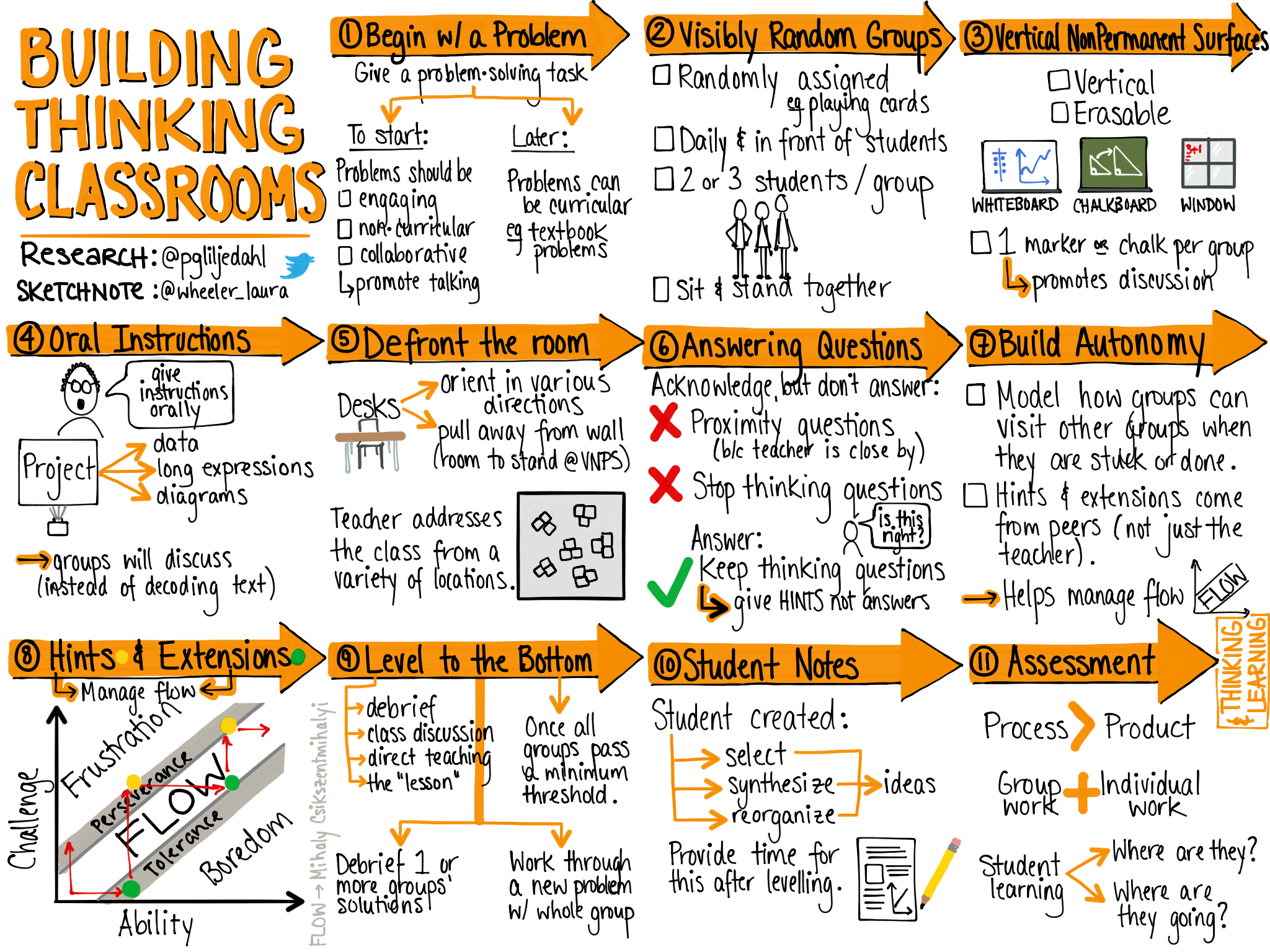
In a BTC classroom, students are routinely asked to grapple with challenging tasks in visibly collaborative ways. They work in randomly assigned groups, think at vertical non-permanent surfaces, and engage with problems that invite multiple approaches rather than a single correct answer.
When this structure is applied to sentence expansion, the “problem” becomes linguistic and conceptual rather than numerical. Instead of solving an equation, students reason together about how best to clarify meaning, add precision, or connect ideas within a sentence. Habits of mathematical thinking become habits of language and meaning-making: making choices, justifying reasoning, revising in response to peers.
This shift is especially powerful for multilingual learners. BTC normalizes struggle as part of learning, which aligns closely with research on language development and academic risk-taking.
When students collaboratively expand a kernel sentence, they are not merely editing; they are negotiating meaning, testing syntax, and building shared understanding. The vertical surfaces make thinking visible, allowing teachers and peers to notice patterns in language, compare approaches, and refine ideas together.
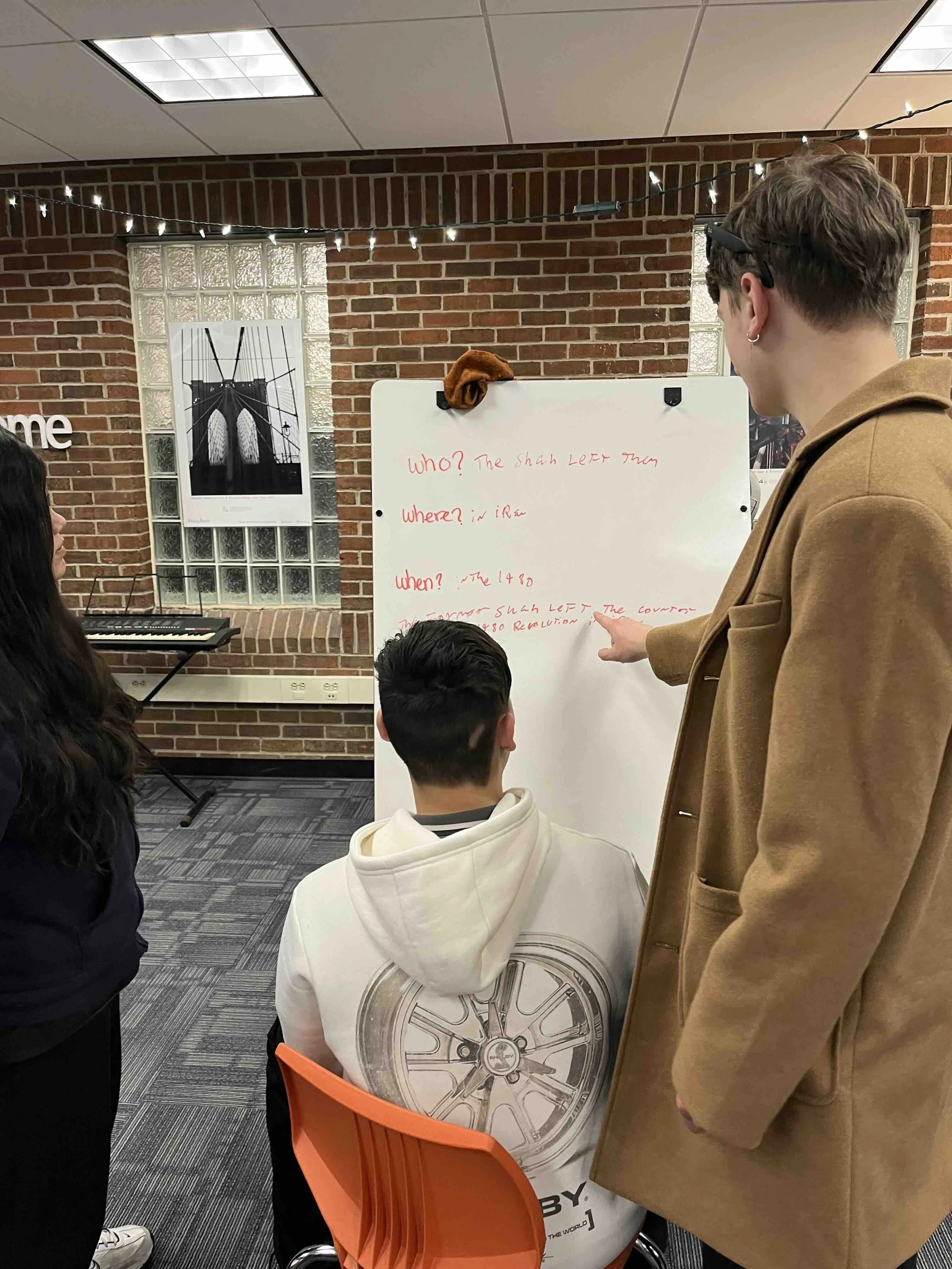

Students in this group collaborated to expand the kernel sentence: “He left.”
Their resulting sentence: “The former shah left the country in 1980 because of the revolution.”
Importantly, BTC also reframes the teacher’s role in ways that support language development. Instead of immediately answering questions or evaluating responses, teachers acknowledge thinking, ask probing questions, and offer hints that nudge students toward clearer expression. This mirrors best practices in literacy instruction, where the goal is to guide students toward more precise language rather than simply providing the “right” sentence.
Seen this way, BTC provides a structure that elevates sentence-level work from a mechanical exercise to a collaborative reasoning task. It creates a classroom culture where language is something students actively build together, much like mathematical understanding.
For teachers, this demonstrates that rigorous, research-aligned literacy instruction can look dynamic, interactive, and deeply aligned with the collaborative spirit of Building Thinking Classrooms.
Scaffolding for Multilingual Learners
To make sentence-level work more accessible, teachers can integrate SIOP-aligned scaffolds, such as:
Visual organizers: Diagrams and anchor charts mapping clauses, appositives, and vocabulary connections. I particularly like Jeff Anderson’s approach to language for my sentence-level anchor charts.
Collaborative discussion protocols: Pair or small-group conversations encourage students to reason aloud and refine sentence structures together.
Word walls: In my classroom, students literally rip words off of the wall and stick them up as they work at the whiteboard. If they don’t, I do!
These supports do not lower cognitive demand. Instead, they make reasoning visible and allow students to focus on meaning while experimenting with language.
Connecting to Background Knowledge
Students often struggle not because concepts are difficult, but because the sentences describing them are linguistically complex or unfamiliar. This is an important distinction.
Sentence expansion offers a way to embed context and relevant vocabulary while bridging gaps in prior knowledge.
Example:
Kernel: “It produces oxygen.”
What? . . . . . . . . . . . . . . . . . . . . . . . . . . . . . . . . . . . . . . . . . . . . . . . . . . . . . . . .
Expanded: “Photosynthesis, the process by which plants convert sunlight, water, and carbon dioxide into energy, produces oxygen.”
Here, students access key vocabulary, see relationships between ideas, and practice constructing complex sentences that clearly convey meaning.
How Teachers Can Implement Sentence Expansion
Teachers ready to implement these strategies can follow a simple sequence:
Identify a kernel sentence from your content lesson: a factual statement, observation, or key concept.
Model expansion for students, thinking aloud about your choices for clauses, interrupters, and vocabulary.
Have students work collaboratively with one marker per group to expand sentences, exploring multiple possibilities.
Provide scaffolds as needed with sentence frames, color-coded clauses, or visual diagrams.
Reflect and share: discuss how sentence expansion clarifies meaning, builds vocabulary, and strengthens reasoning.
By applying this method, teachers create an environment where language is both a tool and an object of study, and multilingual learners can access challenging content without lowering rigor.
Small Moves, Big Impact
The key is to see language and content as inseparable. Sentence-level strategies, informed by Hochman, Patterns of Power, and SIOP, combined with BTC principles, create classrooms where students reason, collaborate, and engage deeply with complex ideas.
Even small interventions, like expanding one kernel sentence in a lesson, can make a big difference. Over time, these routines build a classroom culture where language scaffolds, rigorous thinking, and collaborative reasoning reinforce each other.
Sentence expansion is more than a writing exercise. It is thinking made visible through language. It demonstrates how carefully crafted instruction, grounded in research, can unlock content for multilingual learners while strengthening literacy for all students.
A Call to Action
Teachers might begin by identifying sentences in their next lesson that carry the most conceptual weight. Could those sentences become starting points for discussion and reasoning? Could students experiment with expanding, combining, or clarifying them?
Small, intentional moves at the sentence level can transform classroom dynamics, helping every student (and especially multilingual learners) to think deeply, reason clearly, and engage fully with complex content.
By integrating the Hochman Method, Patterns of Power, SIOP strategies, and BTC principles, teachers can design lessons where language instruction and content learning are fully integrated, creating classrooms where students not only understand content but can articulate it with precision, depth, and confidence.