
Why My Newcomers Are Talking About Confirmation Bias

Confirmation bias is not a small concept. It’s abstract. It’s academic. It shows up in psychology, civics, media literacy, and science. On paper, it looks like something reserved for honors classes or upper-level electives.
But confirmation bias is also deeply human.
Everyone has beliefs. Everyone has assumptions. Everyone has experienced a moment where two people saw the same situation and walked away with completely different conclusions.
That universality is a key reason I chose it as a topic of study.
When I introduce confirmation bias, do not asking students to memorize a definition. I’m asking them to notice how people operate. How beliefs shape interpretation. How evidence is selected. How conclusions are formed.
Those ideas already exist in my students’ heads. My job is to give them a way to organize and express them in English.
Frameworks First
A shift that has mattered enormously in my teaching is moving away from “What concept should I teach?” toward “What framework am I asking students to use?”
In this unit, the framework is simple and powerful:
Belief
Evidence
Interpretation
Conclusion
We return to that sequence constantly. We map it onto diagrams. We rehearse it orally. We revisit it with different scenarios.
The language load is carefully controlled, but the thinking is not.
For newer students, that might mean:
Pointing to the left or right side of a diagram
Using prepositions like in, on, top, middle
Completing frames such as, “She believes ___, so she focuses on ___.”
For more advanced students, it means:
Comparing perspectives
Using verbs like analyze, determine, and assess
Writing short paragraphs that explain how bias influences interpretation
Everyone is working on the same idea. Everyone is using the same framework. The difference is how much language they’re producing independently.
Why Confirmation Bias Works So Well for Multilingual Learners
There are a few reasons this topic has been particularly effective.
First, it invites comparison naturally. Compare two people. Two beliefs. Two interpretations. That makes it perfect for practicing structures like on the one hand and on the other hand, even if we later refine when and how those phrases are used.
Second, it lends itself to visuals. Venn diagrams. Side-by-side images. Arrows that show movement from belief to conclusion. Visuals reduce cognitive load without reducing rigor.
Third, it creates an authentic need for academic vocabulary. Words like belief, evidence, and interpretation aren’t decorative here—they’re functional. Students need them to explain what they see.
Finally, it positions students as thinkers. They are not learning English “for later.” They are using English now to explain how people think and act.
That shift matters, especially for adolescents.
A Classroom Snapshot
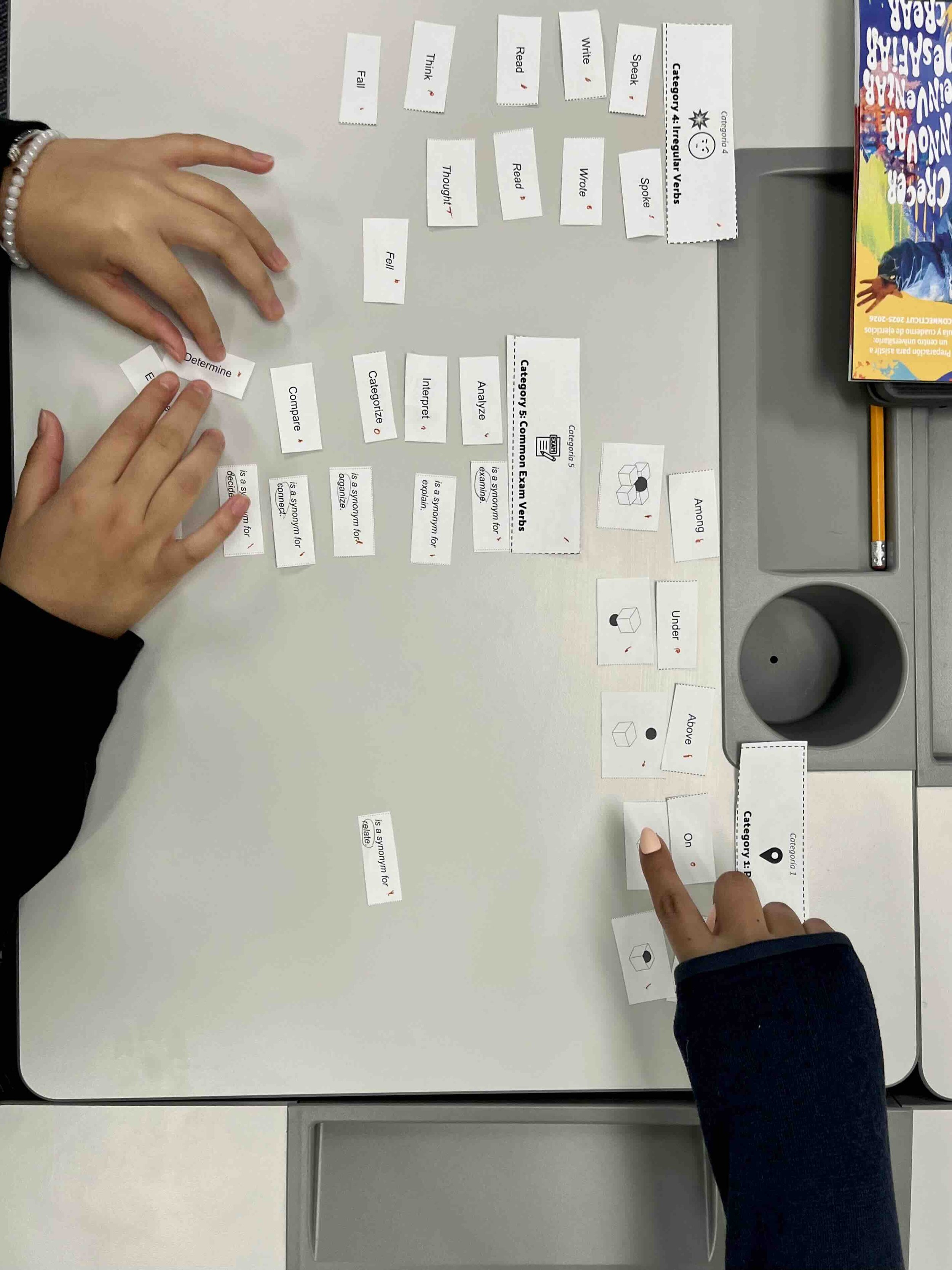
Two newcomers participate in a word sort to identify irregular verbs, prepositions of place, English-Spanish cognates, and confirmation bias related terminology.
In one warm-up, students look at a simple Venn diagram showing two people reacting to the same set of facts. Each person highlights only the facts that support their belief.
The task is straightforward: describe what’s happening.
Some students say, “She believes this, so she only sees this information.”
Others say, “Both people have the same facts, but they make different conclusions.”
No one is asked to define confirmation bias yet. They’re asked to demonstrate it.
Later, when we introduce the term, it sticks—because it names something they already understand.
Consistent Vocabulary
A major goal in this unit is getting students to use academic vocabulary when speaking, not just recognize it on a quiz.
Our word wall is not a static list. It’s a growing toolbox. Students are encouraged to peel words off of the wall and bring them over to their desk while they write.
Words like categorize, compare, interpret, and determine appear in lesson objectives, in speaking frames, in writing prompts, and in quick sorts. Students see how those words change form and how those shifts affect meaning.
Compare becomes comparison
Interpret becomes interpretation
Analyze becomes analysis
…and so on.
Students aren’t just learning words; they’re learning how English builds meaning through word families and patterns. That matters for the long game.
From Simplifying to Amplifying
I used to think my job was to simplify, but I noticed early on that simplification often stripped away what makes learning engaging.
Amplifying a concept with structured speaking and writing opportunities preserves the complexity while making it navigable. It gives students handholds with out holding their hand. Visuals, routines, language patterns, and predictable thinking moves are all essential in my classroom.
Confirmation bias works because the structure is clear. The thinking is repeatable. Students know what to look for and how to talk about it, and they all have examples of when someone they know, “Just could not see the facts!”
When that happens, language development accelerates. And not because it’s easier, but because it’s purposeful.
When they have a framework, they don’t freeze. They don’t wait for the “right” answer. They attempt meaning.
I’ve seen beginners confidently point to a diagram and say, “She believes her father because she like[s] his perspective.” Even if the grammar isn’t perfect, the communication is clear and the idea is there..
The Bigger Takeaway
Teaching confirmation bias to newcomers isn’t about psychology. It’s about equity. The unfortunate reality is that many of my high school newcomers won’t take an AP Psych class.
When we reserve big ideas for fluent speakers, we unintentionally communicate who we think is capable of thinking deeply. We tell a different story when we open those ideas up with structure, scaffolds, and intention.
Frameworks level the playing field. They give all students access to the same intellectual work, even if the language looks different along the way. When students are invited into that work, English stops being the goal and starts being the tool.
That’s when real learning happens.
While this unit grew out of classroom practice, it is strongly aligned with existing research on multilingual learners. Scholars such as Zaretta Hammond and Jim Cummins argue that students develop academic language most effectively when they are engaged in cognitively demanding work supported by strong scaffolds. Rather than simplifying content, this approach structures thinking so students can participate meaningfully even before their English is fluent. Below are a few of the specific sources my work in this unit drew from.
Cummins, J. (2000). Language, power, and pedagogy: Bilingual children in the crossfire. Multilingual Matters.
Echevarría, J., Vogt, M. E., & Short, D. J. (2017). Making content comprehensible for English learners: The SIOP model (5th ed.). Pearson.
Hammond, Z. (2015). Culturally responsive teaching and the brain: Promoting authentic engagement and rigor among culturally and linguistically diverse students. Corwin Press.
Vygotsky, L. S. (1978). Mind in society: The development of higher psychological processes. Harvard University Press.
WIDA Consortium. (2020). WIDA English Language Development Standards Framework, 2020 Edition. Board of Regents of the University of Wisconsin System.